
Why Iran Protests Erupted In Dec 2025
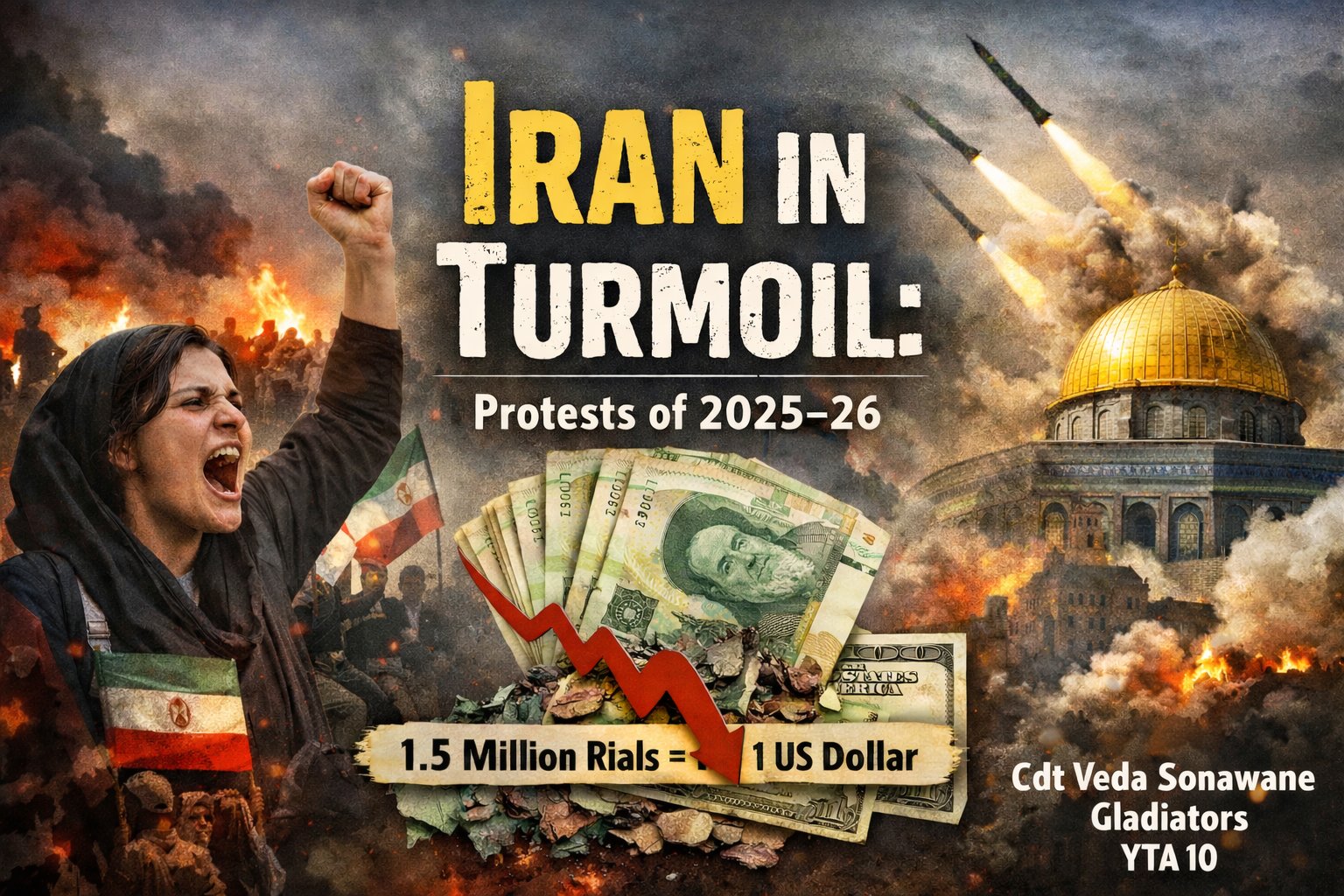
Total View : 225 Date 16 Feb 2026
Why Iran Protests Erupted In Dec 2025
Iran, officially the Islamic Republic of Iran, is a populous West Asian nation with nearly 90 million inhabitants and one of the region’s storied civilisations. Its literacy levels are high for a middle-income country, with an overall literacy rate near 93 per cent and female literacy approaching 99 per cent, reflecting decades of investment in basic education and women’s schooling. Yet beneath this educated society lies a political economy under strain, where economic distress and political frustrations have intersected to produce one of the largest protest movements since the 1979 revolution. The country’s official currency is the Iranian rial, and its economy is heavily influenced by the energy sector (World Bank, 2024).
The Islamic Republic combines elected institutions with powerful unelected bodies. Ultimate authority rests with the Supreme Leader, Ayatollah Ali Khamenei and the clerical establishment. While elections occur, real decision-making power remains outside full public accountability. Over the years, restrictions on speech, assembly and social freedoms, especially for women and youth have fostered recurring cycles of social unrest.
The most recent wave of demonstrations began on 28 December 2025, erupting in Tehran and quickly spreading to Isfahan, Shiraz, Mashhad, Tabriz and Ahvaz. While long-standing grievances provided fertile ground, the immediate catalyst was acute economic distress that had become visible in every Iranian household.
At the heart of this crisis is the collapse of Iran’s currency, the rial. In early 2023, before the escalation of regional conflicts such as the Gaza war, the open-market exchange rate was roughly 500,000 rials to one US dollar. By the end of 2025, the rial had plummeted to record lows, hovering around 1.5 million rials to USD 1 in unofficial markets. It was the weakest level in the nation’s history. This relentless depreciation represents a loss of more than half the currency’s value in just a few years. (Reuters, 2026).
The decline in the rial has had everyday consequences for ordinary Iranians. Inflation, officially reported at over 42 percent in late 2025, eroded purchasing power and made the cost of necessities soar. (India’s inflation rate is 2.75 percent in January 2026) (Freedom House, 2024).
For families living on fixed incomes, the impact was palpable. A weekly shop that might have cost 3 million rials a couple of years earlier could demand 7 million or more as the rial drove Southwards. Staples such as rice, milk and bread became harder to afford. A litre of petrol priced in rials soared, pushing up transport costs for commuters and truckers alike. Many households saw savings rapidly lose value, prompting a rush to buy dollars or gold as a hedge. This behaviour deepened the currency’s slide (International Monetary Fund, 2025).
While economic distress was central, the protests tapped into broader social and political discontent. The death of Mahsa Amini in September 2022, in the custody of Iran’s morality police, had already ignited nationwide demonstrations, especially among women and youth and had left a lasting mark on Iranian society. Though that earlier protest wave was suppressed, the memory of her death remained a potent symbol of state overreach and demand for dignity and rights. (The New Indian Express)
Another factor in the protest narrative was criticism of Iran’s foreign policy, particularly its regional military engagements. For decades, Tehran has positioned itself at the centre of what it calls the “Axis of Resistance”. A network of armed groups and proxies that includes Hamas in Gaza, Hezbollah in Lebanon and the Houthi movement in Yemen. Through the Islamic Revolutionary Guard Corps and its Quds Force, Iran has provided these groups with funding, training and weapons systems as part of a strategy to project influence and counter Western and Israeli power in the region.
The Gaza war that erupted in late 2023 and Iran’s vocal support for Palestinian forces further intensified scrutiny at home. Many Iranians, grappling with rising prices and economic insecurity, questioned the prioritisation of external military assistance over pressing domestic needs. Slogans linking “Neither Gaza nor Lebanon” alongside calls for economic justice surfaced in protest chants, underscoring how foreign policy and domestic hardship had become intertwined in public discourse.
In summary, the 2025–26 protests in Iran were the product of intersecting crises. A collapsing currency that drove prices beyond reach for many, political repression that narrowed avenues for peaceful change and a sense among citizens that their country’s resources were diverted abroad at a time when survival at home had become a daily struggle. When education and awareness meet desperation in the marketplace, society’s pressure points can snap and in Iran’s case, they have.
“When people can no longer survive in silence, protest becomes their only voice.”
BIBILOGRAPGHY
1. Amnesty International (2023) – Iran: Human Rights Report
2. BBC News (2022) – Iran Protests Explained
3. Reuters (2026) – Iran Economic Crisis and Protests
4. Al Jazeera (2026) – Timeline of Iranian Protests
5. World Bank (2024) – Iran Country Overview
6. IMF (2025) – Iran Economic Outlook
7. Freedom House (2024) – Freedom in the World: Iran
8. The New Indian Express
Cdt Veda Sonawane
Gladiators
YTA 10
© Yashotej Academy