
Silent Approach, Devastating Impact: Operation Trident
Total View : 146 Date 12 Jan 2026
Silent Approach, Devastating Impact: Operation Trident
यच्च समुद्रे अधिकारः तस्य जगति प्रभावः।
(He who commands the seas, commands influence in the world.)
The Indian Navy, guided by its motto “Sham No Varunah”, guards the nation’s interests across vast oceans while ensuring security for the land beyond the shoreline. In the annals of modern Indian military history, the Navy’s role in the 1971 Indo–Pak War stands out as one of its most decisive and iconic contributions, a legacy that continues to inspire sailors to this day.
The Background
There is an old saying that the sea gives endlessly, but when exploited without restraint, it responds with unforgiving force. In 1971, it was upon the seas that India chose to strike decisively.
The Indo–Pak War of 1971 was the result of multiple converging factors. The first was the political crisis in East Pakistan, where Sheikh Mujibur Rahman and the Awami League won a clear majority in the 1970 general elections, but the Pakistani leadership refused to transfer power. This led to widespread unrest.
The second and most brutal trigger was Operation Searchlight, launched by the Pakistan Army on 25 Mar 1971, aimed at crushing the Bengali nationalist movement. The operation resulted in widespread atrocities against civilians, students and political leaders, triggering a massive humanitarian crisis.
The third factor was the unprecedented influx of millions of refugees into India, placing immense strain on its economy and administration.
Finally, Pakistan launched pre-emptive air strikes on Indian airfields in the Western sector on 03 Dec 1971, formally widening the conflict. These events culminated in the Indo–Pak War of 1971, which ended in a decisive Indian victory.
Offensive, Not Defensive
The situation in East Pakistan had led to genocide and humanitarian suffering on a massive scale. As refugees poured into India, tensions escalated further. Recognising that a prolonged defensive posture would be costly, India’s military leadership opted for bold, offensive action.
Two towering figures shaped this approach: Field Marshal Sam Hormusji Framji Jamshedji Manekshaw, the Chief of the Army Staff, and Adm SM Nanda, the Chief of the Naval Staff. Together, they endorsed a strategy that history would remember for its clarity of purpose and decisive execution—an offensive approach that struck at Pakistan’s vital centres of power.
The Objective
The Indian Navy was assigned two critical tasks. In the East, it was to impose a naval blockade on East Pakistan, cutting off reinforcement and escape routes. In the West, it was tasked with striking Karachi, Pakistan’s principal naval base, a hub for maritime trade, fuel storage and naval operations.
The Naval Deployment
In the Eastern theatre, INS Vikrant launched air strikes against ports such as Chittagong, effectively paralysing Pakistan’s naval presence. In response, Pakistan deployed PNS Ghazi, a long-range submarine, to hunt down Vikrant. However, Ghazi met its fate off Visakhapatnam, where it sank on 04 Dec 1971, with the loss of all hands, after a sequence of events involving Indian naval action and internal explosions.
In the West, a Karachi Strike Group was formed around fast and lethal Vidyut-class missile boats—INS Nipat, INS Nirghat and INS Veer. These boats possessed exceptional speed and striking power but limited range. To overcome this, the Navy employed Arnala-class anti-submarine corvettes such as INS Katchall and INS Kadmat for escort duties. Special fuel bases were established at Okha and Diu, while INS Poshak provided logistical support en route.
Operation Trident
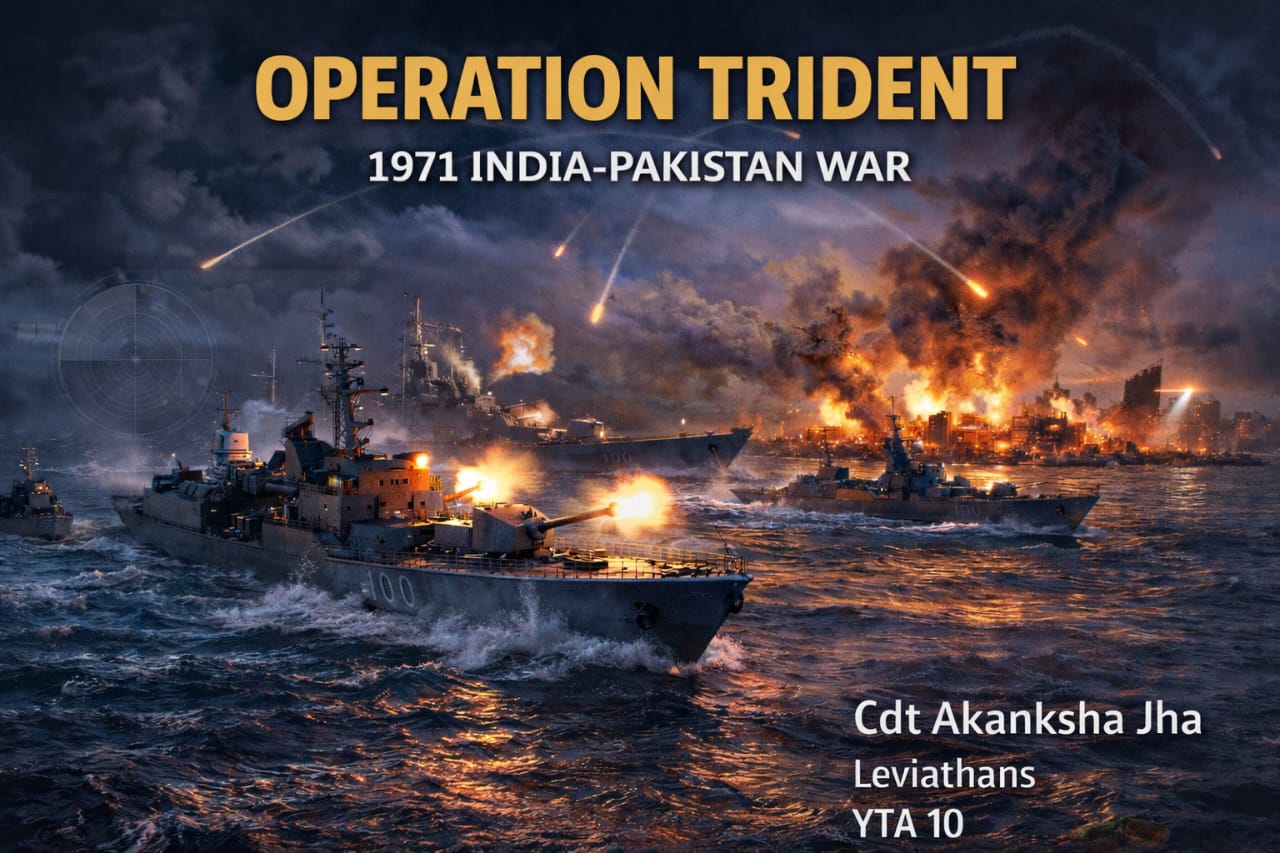
On the night of 04 Dec 1971, the strike group closed to about 250 nautical miles south of Karachi. The attack was deliberately timed to exploit Pakistan Air Force’s limited night-fighting capability. Using radar and electronic intelligence, Indian missile boats detected enemy targets.
INS Nirghat fired the first Styx missile, crippling PNS Khaibar. INS Nipat and INS Veer followed up with devastating precision. PNS Muhafiz, which attempted to respond, was sunk soon thereafter. Indian missiles also struck merchant vessels carrying military supplies and ignited oil storage facilities near Karachi harbour. The resulting fires lit up the night sky and caused severe damage to Pakistan’s fuel reserves and morale.
Operation Python
After the shock of Trident, Pakistan increased coastal surveillance and attempted to mask naval vessels among merchant traffic. Anticipating this, the Indian Navy launched Operation Python on 08 Dec 1971.
A smaller strike group led by INS Vinash, accompanied by frigates INS Talwar and INS Trishul, struck Karachi again. Missiles hit fuel storage tanks and merchant vessels, triggering massive fires. These strikes destroyed a significant portion of Karachi’s fuel infrastructure, severely limiting Pakistan Navy’s operational capability for the remainder of the war.
Strategic Impact
The damage inflicted on Karachi was decisive. Pakistan’s naval operations were crippled, its fuel reserves devastated and its fleet confined to harbour. These operations demonstrated the power of bold leadership, joint planning and innovative use of limited resources.
The seamless coordination between the Indian Navy and the Indian Air Force, particularly strikes on air bases such as Masroor, ensured air superiority and protected naval forces. Together, the two services paralysed Pakistan’s war-making capacity at sea.
Operation Trident and Operation Python stand as enduring examples of offensive maritime warfare, proving that control of the seas can decisively shape the outcome of a war. These actions etched history and remain a source of pride for every Indian.
JAI HIND
Cdt Akanksha Jha
Leviathans
YTA 10
© Yashotej Academy